
Updated June 2026 | Originally published March 2019
What is nicotinamide riboside?
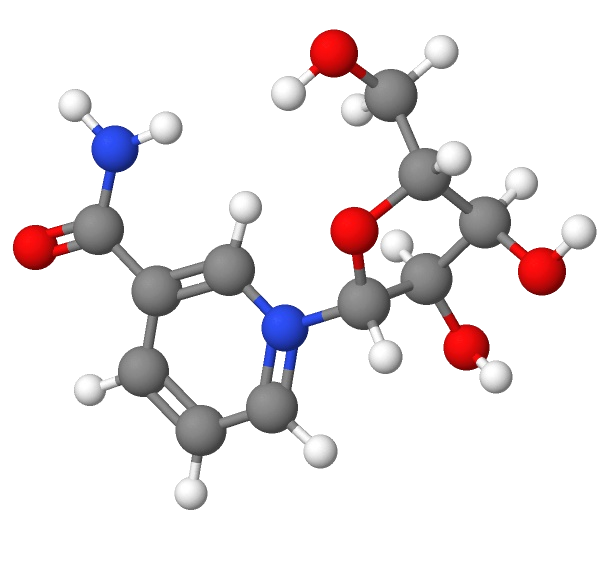
Nicotinamide riboside (NR) is a form of vitamin B3 that the body converts into nicotinamide adenine dinucleotide (NAD+), a coenzyme found in every living cell. NAD+ is essential for cellular energy production, DNA repair, and communication between the cell nucleus and the mitochondria — the energy-producing structures inside your cells. Without adequate NAD+, mitochondria can’t produce the ATP (adenosine triphosphate) energy our cells depend on, and cellular repair processes slow down.
NAD+ levels are highest at birth and decline steadily with age. Certain lifestyle factors — including overeating, sedentary behavior, and alcohol consumption — accelerate that decline. The idea behind NR supplementation is straightforward: if you can raise NAD+ levels, you may be able to slow or partially reverse some of the cellular effects of aging.
That idea is well-supported in animal studies. Whether it holds in humans is where things get more complicated.
Where to buy NR
NR supplements are available from several companies. The most established:
- Tru Niagen (Niagen Bioscience, formerly ChromaDex; NASDAQ: NAGE) is the market leader and the most extensively studied NR product, with 45+ published clinical studies using its patented Niagen® ingredient. The 300mg capsule is the entry-level option (~$40/month for 30 capsules); the 1,000mg Pro version runs ~$116/month. Tru Niagen now accepts health savings account (HSA) and flexible spending account (FSA) payments.
- Elysium Health Basis combines 250mg of NR with 50mg of pterostilbene, a resveratrol-related compound, for approximately $38/month. A 2017 clinical trial showed Basis raised NAD+ levels significantly, but also found a small but notable increase in low-density lipoprotein (LDL) cholesterol — worth discussing with your doctor if cardiovascular risk is a concern.
Other NR-containing products are available from Life Extension, Thorne, and a growing number of generic brands. Quality varies significantly. Independent testing by Niagen Bioscience in 2025 of 22 top-selling NAD+ products on Amazon found that 55% contained little to no active ingredient. If you’re going to spend money on this supplement, choose a product with third-party testing and a verified certificate of analysis.
NR vs. NMN: the competitive landscape
For several years, nicotinamide mononucleotide (NMN) was unavailable in the US as a dietary supplement after the U.S. Food and Drug Administration (FDA) ruled in 2022 that it had been investigated as a drug before being marketed as a supplement. That changed in September 2025, when the FDA reversed course and confirmed NMN is lawful for use in dietary supplements. NMN products have since returned to Amazon and other US retailers.
The key scientific distinction: NR enters cells directly and is converted to NAD+ inside them, while NMN must be converted to NR before crossing the cell membrane — adding a step. Niagen Bioscience contends this makes NR the more efficient precursor. NMN advocates argue the difference is minimal in practice. The honest answer is that head-to-head human comparison data remain limited. NR has significantly more published human trial data — roughly double NMN’s clinical evidence base at this point.
What the clinical trials show
The most consistent finding across 60+ registered clinical trials is that NR reliably raises NAD+ levels in humans. A 1,000mg daily dose has raised blood NAD+ by approximately 33% in clinical studies, with some trials showing increases up to 142% at higher doses.
Whether that NAD+ increase translates to meaningful health outcomes is where the evidence is thinner. Here is an honest summary of what has and hasn’t been shown in human trials:
What has been shown:
- NR consistently and safely raises NAD+ levels in humans at doses from 300mg to 2,000mg daily, without serious adverse effects
- A 2024 Nature Communications trial (the NICE trial) found NR improved six-minute walk distance in people with peripheral artery disease (PAD), with adherent participants improving by approximately 31 meters compared to placebo — a meaningful functional improvement in this population
- A 2025 clinical trial published in eClinicalMedicine found NR (2,000mg/day) improved cognitive symptoms and NAD+ levels in long COVID patients over 24 weeks
- A pilot trial in older adults with PAD found signals of vascular and cognitive benefit after 4 weeks of NR supplementation
- Preliminary trials show possible benefits for blood pressure reduction, though sample sizes have been too small to reach statistical significance
What has not been shown (yet) in humans:
- Improved insulin sensitivity, glucose metabolism, blood lipids, or body composition in obese men (12-week study, n=40)
- Conclusive improvement in chronic fatigue syndrome, dementia, Parkinson’s symptoms, or functional energy levels
- The dramatic geroprotective effects seen in animal models — where older animals returned to 15–20% more youthful states — have not been replicated in human trials
- A 2025 systematic review found evidence on NR’s effects on skeletal muscle mass and function in older adults remains inconclusive
The honest takeaway: NR does what it says on the label — it raises NAD+ — and it does so safely. The gap between “raises NAD+” and “produces measurable health benefits” in healthy humans has not yet been convincingly closed. People with specific conditions (PAD, long COVID) may have more reason to consider it than healthy adults seeking general anti-aging effects.
Dosage
Most clinical trials have used 1,000mg daily (typically two 500mg doses). Niagen Bioscience recommends 1,000mg/day. A 300mg dose has been shown to raise NAD+ by over 50% and is the standard entry-level serving. NR has been tested at up to 2,000mg/day without serious adverse effects.
Safety and adverse effects
NR received generally recognized as safe (GRAS) status from the FDA in 2016 and has been approved by Health Canada, the European Food Safety Authority (EFSA), and Australia’s Therapeutic Goods Administration (TGA). It is naturally present in small amounts in cow’s milk. Across multiple human trials, it has not produced serious adverse effects at doses up to 2,000mg/day. The most commonly reported minor effects are mild gastrointestinal discomfort and, in rare cases, headache.
The cancer question: This deserves careful treatment because it has received significant and sometimes alarmist media coverage. The concern originates from a 2022 preclinical study (Maric et al.) that found NR increased metastasis of triple-negative breast cancer cells to the brain in a mouse model. Subsequent coverage amplified this finding considerably.
The current state of the evidence is more nuanced. Multiple other studies have found NAD+ supplementation suppresses tumor growth in other cancer types (hepatocellular carcinoma, some breast cancer models). A 2024 review in Cancers (MDPI) concluded the animal evidence warrants caution but is not sufficient to establish harm in healthy humans taking normal doses. The consensus among researchers is that available human data do not suggest increased cancer risk from NR at standard doses — but that people with a personal history of cancer should discuss NAD+ supplementation with their oncologist before taking it.
A separate 2026 study from Case Western Reserve University found that NAD+ precursors (NMN, NR, and nicotinamide) may help pancreatic cancer cells resist treatment. Again: this is preclinical research, not a clinical trial in humans, but it reinforces the importance of the cancer-history caveat.
Who should consider NR
NR is most likely to offer benefit to:
- People with peripheral artery disease, based on the NICE trial’s functional walking improvements
- People managing long COVID symptoms, based on the 2025 eClinicalMedicine trial
- People with documented, accelerated NAD+ depletion (heavy drinkers reducing their intake, people recovering from significant illness or metabolic stress)
For healthy middle-aged adults seeking general anti-aging effects, the evidence is promising but not yet definitive. If you’re considering NR as part of a broader supplement strategy, see our article on anti-aging dietary supplements for context on how it fits alongside other well-studied options.
For those with a personal or family cancer history, discuss with your physician before starting.
Keep.Health’s take
NR is one of the more scientifically serious supplements in the longevity space — not because the human evidence is definitive, but because the underlying biology is sound and the safety profile is well established. The trial base is growing, and the results in specific populations (PAD, long COVID) are encouraging. It deserves a more careful assessment than most supplements get, and it also deserves more honesty about what is and isn’t proven.
If you’re in good health and considering NR purely for anti-aging purposes, it may be worth taking — but treat it as a promising bet on emerging science, not a proven intervention. If you have PAD or are recovering from long COVID, the evidence is more actionable.
Either way: choose a tested product, start at 300mg, and don’t ignore the cancer caveat if it’s relevant to your history.
Frequently asked questions
What is nicotinamide riboside used for? Nicotinamide riboside is a vitamin B3 precursor used to raise NAD+ levels in the body. It is most commonly taken to support cellular energy production, mitochondrial function, and healthy aging. Clinical evidence also supports its use for improving walking capacity in peripheral artery disease and managing long COVID symptoms.
Does NR actually raise NAD+ levels? Yes — this is the most consistently demonstrated finding across human clinical trials. Doses of 300mg to 1,000mg daily have been shown to raise blood NAD+ by 50% to over 140%, depending on dose and individual response.
Is nicotinamide riboside safe? NR has received GRAS status from the FDA and has been tested in human trials at doses up to 2,000mg/day without serious adverse effects. People with a personal history of cancer should consult their doctor before taking it, based on preclinical research suggesting potential interactions with some cancer types.
What is the difference between NR and NMN? Both are NAD+ precursors. NR enters cells directly to be converted into NAD+, while nicotinamide mononucleotide (NMN) must first be converted to NR before crossing the cell membrane. NR has roughly double the published human clinical evidence compared to NMN. NMN was unavailable in the US from 2022 until September 2025, when the FDA reversed its exclusion ruling.
Sources
- Tru Niagen / Niagen Bioscience
- Elysium Health
- NICE Trial — Nature Communications (2024)
- NR and long COVID — eClinicalMedicine / The Lancet (2025)
- NR and cancer risk — Cancers, MDPI (2024)
- NR and skeletal muscle — Journal of Cachexia, Sarcopenia and Muscle (2025)
- FDA NMN reversal — Natural Products Association (September 2025)
- NAD+ supplement quality testing — Niagen Bioscience / AboutNAD (2025)
- Consumer Lab
- ClinicalTrials.gov — NR trials
